
Twelve Years of Historic Rental Income Disclosed, Returns Filed, and HMRC Penalties Reduced from 100% to 10%
Client: Dean W
Client type: Property owner and landlord
Services provided: Let Property Campaign, Personal Tax and Self Assessment, Digital Disclosure, HMRC Liaison, Ongoing Compliance
Dean contacted Total Books Accountants in November 2021 with a situation that many landlords quietly worry about but rarely talk about. He had 12 years of historic rental income that had not been fully declared, and self-assessment returns that were overdue across the same period. The longer it went on, the heavier it felt. He was concerned about penalties, worried about how HMRC would react, and unsure how to start fixing it without making things worse.
He needed two things at the same time: a team that could do the work accurately, and a team that could deal with HMRC properly. Through our Let Property Campaign, Personal Tax and Digital Disclosure support, we brought his tax affairs up to date and reduced penalties from 100% down to 10%, which is a 90% reduction.
This case study explains what happened, what we did, and why a structured disclosure approach changed the outcome.
What challenges was Dean facing?
Dean’s case had a mix of technical and emotional pressure. Both matter, because stress often slows action.
1) Twelve years of unfiled or incomplete compliance
Over a decade of historic tax issues creates compounding complexity:
multiple tax years to reconstruct
changing rental income, expenses, and tenancy periods
missing paperwork in places and inconsistent record keeping
the risk of contradictions across years if the work is rushed
This is not the kind of situation where a single form fixes everything. It needs a year-by-year approach.
2) Risk of maximum penalties
HMRC penalties on undeclared income can be severe. Dean was worried about a worst-case outcome, including the possibility of HMRC applying penalties at the top end.
That fear is not irrational. It is the reason many landlords delay. They assume the moment they speak to HMRC, the outcome will be harsh. Dean needed a safer, structured path that showed cooperation and credibility.
3) Complex calculations and uncertainty
Dean wanted to understand the numbers. He did not want submissions made “in the background” without transparency. He needed:
clarity on what was being declared
confidence that calculations were correct
reassurance that the method would hold up to HMRC review
4) Anxiety about HMRC contact
Dealing with historic issues can feel intimidating. Dean did not want to speak to HMRC alone, especially when he was unsure about language, process, and consequences. He wanted professional representation that removed the pressure.
What was Dean trying to achieve?
We agreed clear objectives from the outset.
Achieve full tax compliance by submitting historic rental income and overdue self-assessment correctly.
Use the Let Property Campaign as the proper disclosure route for historic landlord issues.
Reduce penalties with a strong mitigation case and professional HMRC liaison.
Build a workable system so the same problem would not return in future years.
How did Total Books approach the case?
We used a structured process designed to reduce risk and keep everything consistent across 12 years.
Step 1: Establish the facts and rebuild the timeline
We started with a detailed consultation and a practical plan. We mapped out:
-
the rental history across the 12 years
-
where data existed and where reconstruction was needed
-
what evidence could support each year
-
what the final disclosure needed to include
Then we gathered and rebuilt records year-by-year using the most reliable available information. This part is vital, because historic filings have to make sense as a complete story, not a pile of disconnected returns.
Step 2: Prepare the Let Property Campaign disclosure
For landlords with historic undeclared rental income, the Let Property Campaign provides a recognised disclosure route.
We prepared and submitted Dean’s historic property income through this framework. That included:
-
reconstructing rental income and allowable expenses across each relevant year
-
producing clear calculations that could be followed and defended
-
keeping the submission consistent and coherent across the entire period
Alongside the figures, we prepared a mitigation case. This is where many submissions fail. Numbers alone rarely explain why a situation happened or why penalties should be reduced. We drafted a detailed mitigation letter that presented Dean’s position clearly and professionally.
Step 3: Bring personal tax and self-assessment into line
In parallel, we prepared and submitted overdue self-assessment returns. Each year required careful treatment, including correct classifications and checks.
Dean wanted transparency, so we reviewed calculations with him, explained how the figures were built, and made sure he understood what was being submitted and why. That gave him confidence and reduced the stress that comes from not knowing what is happening behind the scenes.
Step 4: HMRC liaison and penalty negotiation
Once submissions were ready, we dealt directly with HMRC on Dean’s behalf.
This stage is where experience matters most. The way the case is presented, the tone, the supporting explanation, and the structure of the mitigation all influence outcomes.
Our work resulted in HMRC reducing penalties from 100% down to 10%. That changed the financial outcome and brought the case to a close in a controlled way.
Step 5: Ongoing compliance support
After resolution, we put a simple compliance process in place so Dean could stay on track going forward. For landlords, that typically includes:
-
a clear method for tracking rental income and property expenses
-
year-end preparation support
-
ongoing self-assessment handling
-
early guidance to prevent last-minute pressure
The aim is simple: never return to historic disclosure again.
What results did Dean achieve?
Dean’s results were clear and measurable.
-
All historic property income was disclosed and addressed through the Let Property Campaign.
-
Overdue tax obligations were brought up to date, restoring full compliance.
-
Penalties were reduced from 100% to 10%, which is a 90% reduction.
-
A long-term relationship was established, with Total Books now supporting Dean for future submissions.
Beyond the numbers, the biggest change was relief. Once the process began, the fear of “what might happen” was replaced with a plan and clear progress.
Client testimonial
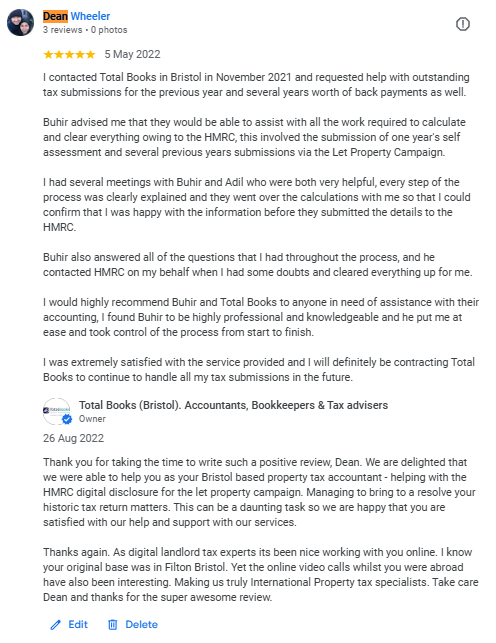
“I contacted Total Books in Bristol for help with outstanding tax submissions and several years of back payments. Buhir and Adil were incredibly helpful, explaining every step and reviewing all calculations with me. They even contacted HMRC on my behalf to clear up concerns. I was extremely satisfied and will definitely continue working with Total Books. Highly professional, knowledgeable, and reassuring from start to finish.”
Why this case matters for other landlords
Dean’s story matters because it shows that historic landlord tax issues can be resolved without panic, when you take the right route and do the work properly.
If you are a landlord with:
-
undeclared rental income
-
missed self-assessment years
-
anxiety about HMRC letters or penalties
-
uncertainty around allowable expenses and calculations
there is a structured path forward. The Let Property Campaign exists for a reason, and penalty outcomes can change when the disclosure is handled with accuracy, context, and professional representation.
Conclusion
Dean came to Total Books Accountants with 12 years of historic property tax issues and real concern about the financial consequences. We rebuilt the facts, prepared the correct disclosure route through the Let Property Campaign, filed overdue self-assessment returns, and handled HMRC communication with a strong mitigation strategy.
The final outcome was full compliance and penalties reduced from 100% to 10%.
If you are in a similar position, the most valuable step is not guessing what HMRC will do. It is getting a clear plan, accurate calculations, and a disclosure process that protects your position.